The Common Black Hawk’s Refraction-Defying Hunt: Precision, Physics, and Predation at Water’s Edge
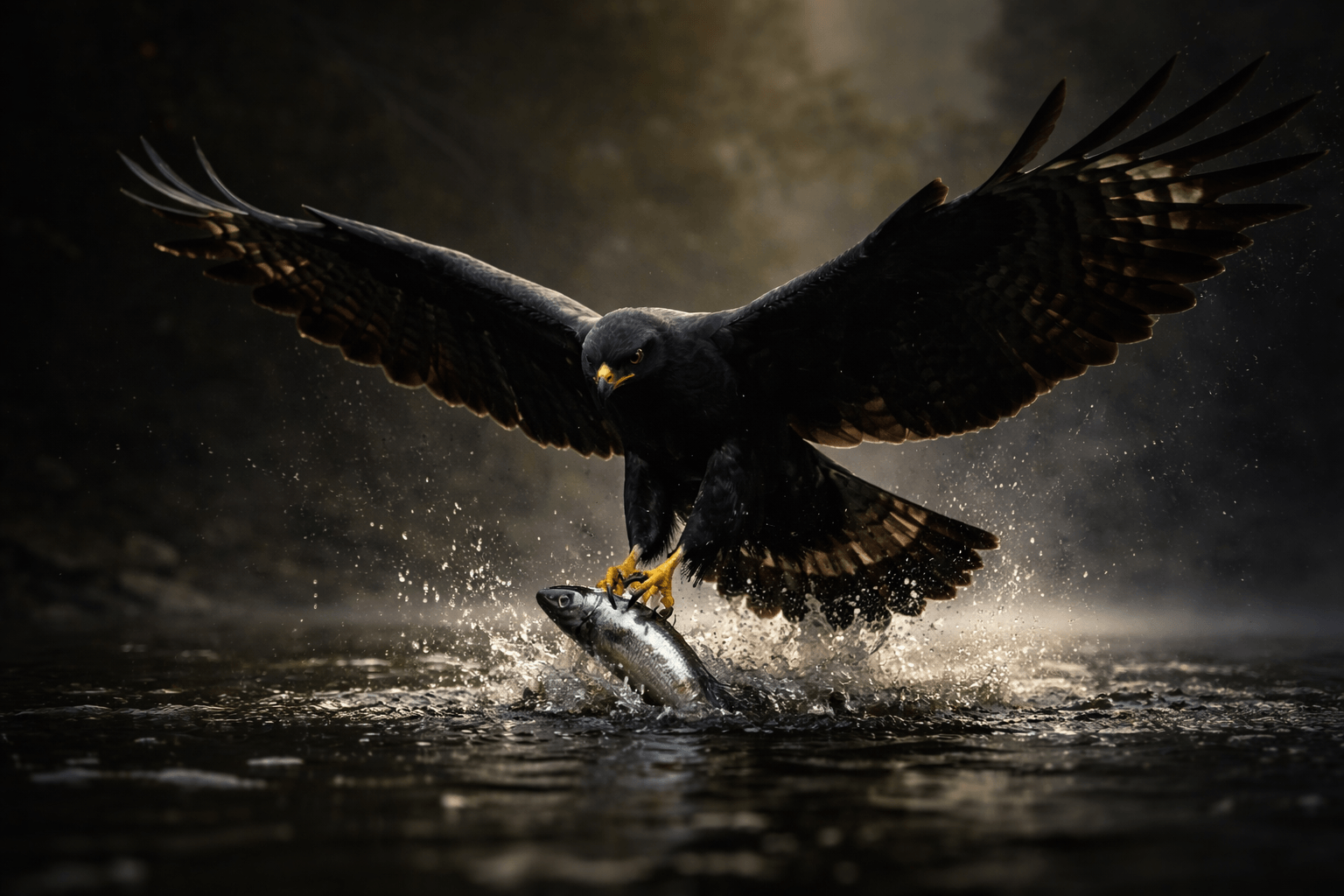
A Common Black Hawk demonstrates its low-altitude glide and split-second talon strike, overcoming water glare and refraction to capture prey with remarkable accuracy.

Introduction
The Common Black Hawk is one of the most fascinating raptors in the Americas, a bird that defies expectations about what hawks can do. While many hawks dominate open skies and terrestrial hunting grounds, this species has evolved into a highly specialized aquatic predator. Its ability to glide low over rivers, compensate for optical distortion, and strike prey beneath the water’s surface makes it a remarkable case study in evolutionary adaptation.
Found near rivers, mangroves, and coastal wetlands, the Common Black Hawk thrives in environments where water meets land. Here, it leverages a unique combination of anatomical precision, behavioral intelligence, and physical efficiency to hunt fish, crabs, and amphibians. This article explores how this raptor turns physics into an advantage, mastering glare, refraction, and timing to achieve near-surgical strikes.
Distribution and Habitat
The Common Black Hawk inhabits a broad geographic range extending from the southwestern United States through Mexico, Central America, and into parts of South America. Despite this range, it is highly selective about habitat, preferring areas with reliable access to shallow water and abundant aquatic prey.
- Primary habitats include rivers, streams, estuaries, and mangrove forests
- Often found at low elevations, especially near coastal regions
- Requires perching sites such as trees or rocky outcrops near water
- Territorial pairs frequently return to the same nesting sites year after year
In the United States, populations are concentrated in Arizona and Texas, where riparian ecosystems provide ideal hunting conditions. These environments are critical not just for feeding but also for breeding and raising young.
Physical Adaptations for Aquatic Hunting
The Common Black Hawk’s success as an aquatic predator is rooted in its physical design. Every aspect of its anatomy contributes to its ability to hunt effectively in challenging visual and environmental conditions.
Key Features
- Broad wings: Enable slow, controlled gliding just above water surfaces
- Short tail: Enhances maneuverability during low-altitude flight
- Powerful talons: Adapted for gripping slippery prey like fish and crabs
- Hooked beak: Ideal for tearing aquatic prey
- Dark plumage: Reduces glare reflection and provides camouflage
These adaptations allow the hawk to maintain stability and precision while flying mere inches above the water—a zone where most birds would struggle to maintain control.
The Physics of Hunting Over Water
Hunting over water introduces unique visual challenges. Light bends when passing from air into water, a phenomenon known as refraction. This causes objects beneath the surface to appear shifted from their true position.
For predators, this distortion can mean the difference between success and failure. The Common Black Hawk has adapted to compensate for this effect, adjusting its strike angle to account for the apparent displacement of its prey.
- Refraction causes prey to appear closer to the surface than it actually is
- The hawk instinctively adjusts its talon trajectory downward
- Strike timing is calibrated to milliseconds
- Low-angle approaches reduce glare and improve visibility
By mastering these physical constraints, the hawk effectively “solves” a complex optical problem in real time, turning a disadvantage into a lethal advantage.
Hunting Strategy and Behavior
The Common Black Hawk employs a methodical and energy-efficient hunting strategy. Rather than relying on high-speed dives, it uses stealth and precision to capture prey.
Typical Hunting Sequence
- Perches near water to scan for movement
- Launches into a low-altitude glide
- Tracks prey using keen eyesight
- Adjusts for refraction and glare
- Extends talons at the exact moment of contact
This approach minimizes energy expenditure while maximizing success rates. The hawk’s ability to remain calm and calculated during the hunt is a key factor in its effectiveness.
Diet and Feeding Habits
Unlike many hawks that primarily hunt mammals or birds, the Common Black Hawk has a diet heavily focused on aquatic life.
- Fish make up a significant portion of the diet
- Crabs are a preferred prey in coastal regions
- Also consumes amphibians and small reptiles
- Occasionally scavenges when opportunities arise
Studies suggest that in some regions, crabs can account for over 50% of the hawk’s diet, highlighting its specialization. This dietary flexibility allows it to adapt to seasonal changes in prey availability.
Statistical Insights and Research Findings
Scientific observations have provided valuable insights into the hunting efficiency and ecological role of the Common Black Hawk.
- Estimated hunting success rate: 30–50% per attempt
- Typical glide height: less than 2 meters above water
- Strike duration: under 1 second
- Territory size: approximately 1–3 square kilometers
- Breeding pairs often produce 1–2 chicks per season
These statistics underscore the hawk’s efficiency as a predator and its reliance on stable aquatic ecosystems. Even slight disruptions to these environments can significantly impact its survival.
Reproduction and Lifecycle
The Common Black Hawk forms monogamous pairs that often remain together for life. Their breeding behavior is closely tied to the availability of suitable nesting sites near water.
- Nests are built in tall trees near rivers or wetlands
- Breeding season typically begins in spring
- Clutch size ranges from 1 to 3 eggs
- Incubation lasts about 35–37 days
- Both parents participate in feeding and protection
Juveniles remain dependent on their parents for several weeks after fledging, learning essential hunting skills during this period.
Ecological Importance
As a top predator in its niche, the Common Black Hawk plays a crucial role in maintaining ecological balance. By regulating populations of fish, crabs, and amphibians, it helps sustain healthy aquatic ecosystems.
- Controls prey populations and prevents overpopulation
- Acts as an indicator species for ecosystem health
- Supports biodiversity by maintaining balance
The presence of this hawk often signals a thriving, unpolluted environment, making it an important species for conservation monitoring.
Conservation Status and Threats
While not currently considered globally endangered, the Common Black Hawk faces several localized threats that could impact its populations.
- Habitat loss due to urban development
- Water pollution affecting prey availability
- Climate change altering wetland ecosystems
- Human disturbance near nesting sites
Conservation efforts focus on protecting riparian habitats and ensuring clean, sustainable water systems. Preserving these environments is essential for the long-term survival of the species.
Conclusion
The Common Black Hawk stands as a testament to the power of specialization in nature. By mastering the physics of light and water, it has carved out a unique ecological niche that few other raptors can match.
Its low-altitude glide, precision talons, and refraction-compensating strike transform a challenging environment into a hunting ground of opportunity. Watching this hawk in action is witnessing a seamless blend of biology and physics—a predator that has truly turned science into survival.
As environmental pressures continue to mount, protecting the habitats that sustain this remarkable bird becomes increasingly important. The Common Black Hawk is not just a hunter; it is a symbol of ecological balance and the intricate beauty of adaptation.
The Common Black Hawk represents a striking convergence of biology and physics, where evolutionary refinement has produced a predator uniquely adapted to aquatic environments. Its hunting behavior is not simply instinctual but appears almost calculated, incorporating environmental cues such as light angle, water clarity, and prey motion into a seamless strike sequence. By gliding just above the water’s surface, the hawk minimizes energy expenditure while maximizing visual accuracy, positioning itself for an optimal attack that accounts for the distortions caused by refraction. This capacity to effectively “correct” what it sees reveals the extraordinary sensory and neurological adaptations that underpin its survival. Beyond its hunting prowess, the species plays an essential ecological role, acting as both predator and indicator of environmental health in riparian and wetland ecosystems. Its presence signals balance—clean water, stable prey populations, and intact habitats. However, increasing environmental pressures such as habitat destruction, pollution, and climate variability threaten to disrupt these delicate systems. Protecting the Common Black Hawk therefore extends beyond preserving a single species; it involves safeguarding entire ecosystems that countless other organisms depend upon. In understanding and appreciating this hawk’s remarkable abilities, we gain deeper insight into the intricate relationships that define natural systems and the importance of preserving them for future generations.