Cold War Signals That Refuse to Disappear
Discover how abandoned Cold War satellites can still transmit signals from orbit, including the extraordinary story of LES-1 and its 237 MHz signal.

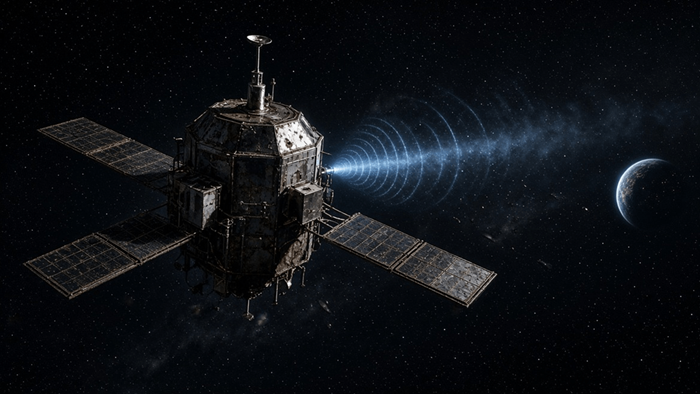
Listen to the remarkable radio signal associated with LES-1, a Cold War experimental satellite launched in 1965 and detected transmitting again decades after its intended mission ended.
How Abandoned Cold War Satellites Are Still Transmitting Data From Deep Orbit
There is something deeply strange about receiving a radio signal from a machine that was built more than half a century ago, launched during the height of the Cold War, abandoned long ago, and left tumbling through space. The engineers who designed it are now part of history, its original mission ended decades ago, and yet a faint electronic whisper can still cross the enormous distance between orbit and Earth.
This is not science fiction. It has happened.
One of the most fascinating examples is Lincoln Experimental Satellite 1, better known as LES-1. Launched in 1965 as part of an experimental military communications programme, LES-1 was intended to investigate technologies that could make satellite communications more reliable and useful over long distances. It was never destined to become a modern communications satellite, but its brief operational career became only the beginning of a much stranger story.
After its intended mission ended, LES-1 became silent. For approximately 45 years, it appeared to be nothing more than another abandoned object orbiting Earth. Then, in 2012, amateur radio operators detected a signal coming from it.
The signal was being transmitted at approximately 237 MHz, a frequency associated with the satellite's telemetry functions. The discovery transformed an obsolete Cold War spacecraft into a remarkable example of technological survival. MIT Lincoln Laboratory subsequently developed a system for recording the signal whenever the satellite passes over its campus in Massachusetts.
LES-1 is particularly intriguing because it demonstrates that a spacecraft does not necessarily become completely silent simply because its mission has ended. Electronics can fail in unexpected ways, solar power can interact with damaged circuits, and components can continue producing signals long after the system that originally controlled them has ceased functioning.
That makes the story of Cold War satellites more than an account of old technology. It is also a glimpse into what happens when human engineering is left alone in space for decades.
The Cold War Created a New Kind of Satellite
The development of experimental military satellites was closely connected to the technological competition between the United States and the Soviet Union. The Cold War was not fought only through armies, aircraft and nuclear weapons. It was also fought through communications, radar, computers, electronics and the ability to understand what was happening across enormous distances.
Space offered an entirely new environment in which these technologies could operate.
The launch of Sputnik 1 by the Soviet Union in 1957 demonstrated that an artificial object could be placed into orbit and could transmit a radio signal back to Earth. That simple beeping signal had enormous political and technological consequences. It showed that satellites could communicate across the planet and that the space above Earth could become strategically important.
Within this rapidly changing environment, researchers began investigating how satellites could support communications between distant military users. Ground-based radio systems were limited by Earth's curvature, terrain and atmospheric conditions. A satellite positioned above the Earth could potentially provide a much longer communications path.
MIT Lincoln Laboratory was already deeply involved in advanced military electronics. Established in 1951 to address the emerging problem of continental air defence, the laboratory had developed technologies involving radar, computers, communications and large-scale information processing. Its work eventually expanded into space technology and satellite communications.
The Lincoln Experimental Satellite programme emerged from this environment. The satellites were not simply designed as replacements for existing communications systems. They were experimental platforms intended to test technologies that could eventually make military satellite communications practical.
- Experimental communications: The LES programme investigated ways of transmitting information through space over long distances.
- Advanced antennas: Engineers explored methods of making satellite antennas more effective despite the limited size and power available aboard spacecraft.
- Signal processing: Different modulation and communications techniques were investigated to improve the usefulness of satellite links.
- Telemetry: Spacecraft systems needed ways to report their own condition back to Earth.
- Reliability: The programme helped investigate how communications could continue when spacecraft encountered difficult conditions in orbit.
The importance of this experimental work extended far beyond the first satellites. The LES programme helped establish technologies and concepts that contributed to later military satellite communications systems.
LES-1 Was Built for an Entirely Different Era
LES-1 was launched in February 1965. At the time, electronics were advancing rapidly, but spacecraft were still remarkably primitive by modern standards. There were no smartphones, no commercial satellite navigation systems and no enormous fleets of compact communications satellites surrounding the planet.
A satellite was a major engineering undertaking.
Every component had to survive launch vibration, extreme temperature changes, radiation and the vacuum of space. Power was limited. Computing resources were tiny compared with even the simplest modern electronic device. Engineers could not simply upload a software update when something went wrong.
LES-1 was designed to demonstrate several communications technologies and form part of a broader experimental programme. However, its mission did not proceed exactly as intended.
The satellite ultimately found itself in an unsuitable orbit after a problem involving its launch vehicle. The resulting circumstances prevented LES-1 from fulfilling the role its designers had originally envisaged. Despite this, the satellite still performed useful experiments before its operational life ended.
After approximately two years of demonstrations, its transmitter was shut down. The satellite then entered a very different phase of its existence: decades of silence.
LES-1 and LES-2 shut down their transmitters in 1967 at the end of their intended lifetimes. For roughly the next 45 years, the satellites remained in orbit.
From an engineering perspective, that should have been the end of the story.
But space has a way of preserving machines long after their creators have stopped using them.
For 45 Years, LES-1 Appeared to Be Dead
When a spacecraft stops transmitting, it can become surprisingly difficult to know exactly what is happening inside it.
There is an important distinction between a spacecraft being inactive and being physically incapable of producing a signal. A satellite may have lost its primary mission, stopped responding to commands, suffered battery failure or entered an uncontrolled state while still retaining some electrical activity.
LES-1 had no operational reason to continue communicating. Its intended mission was finished. Its transmitter had been shut down. Decades passed.
During that period, the spacecraft remained exposed to the environment of space. Solar radiation continued to strike its surfaces. Temperatures changed as it moved through sunlight and darkness. Electronic components aged. Batteries degraded. Insulation and materials slowly changed.
On Earth, an abandoned electronic device eventually becomes covered in dust, corrosion and moisture. Space creates a completely different ageing process. There is no rain and no atmosphere in which ordinary corrosion can occur, but there is radiation, vacuum, thermal cycling and the relentless passage of time.
The satellite therefore became something like an accidental long-term experiment.
Every year it continued to orbit Earth. Every orbit exposed it to another cycle of sunlight and darkness. Every passing decade provided another opportunity for its ageing electronics to behave in ways that the original designers could not necessarily have predicted.
Then something changed.
The Signal That Came Back
In 2012, amateur radio operators detected a telemetry signal from LES-1.
The discovery was extraordinary because the satellite had been silent for roughly four and a half decades. The signal was detected at 237 MHz, within the ultrahigh-frequency range associated with the spacecraft's telemetry. The signal was strong enough to be recognised and investigated despite the satellite having been inactive for decades.
That did not mean LES-1 had suddenly returned to normal operation. It did not regain the sophisticated communications capabilities for which it had originally been designed. Instead, the discovery appears to represent a much stranger phenomenon: part of the spacecraft's electrical system was once again producing a detectable radio transmission.
The exact mechanism has been described as a possibility rather than an absolute certainty. One explanation is that degradation or an electrical short within the power system allowed energy from the solar arrays to reach circuitry associated with the transmitter.
In other words, the satellite may not have deliberately decided to wake up.
It may simply have been receiving sunlight, producing electrical power and routing that power through a circuit that had not behaved this way for decades.
That distinction makes LES-1 even more fascinating. It was not a machine coming back to life in the conventional sense. It was an old electrical system interacting with its environment in an unexpected way.
- Launch: February 1965.
- Intended experimental lifetime: approximately two years of demonstrations.
- Transmitter shutdown: 1967.
- Period of silence: approximately 45 years.
- Unexpected signal detected: 2012.
- Detected frequency: approximately 237 MHz.
How Can an Abandoned Satellite Still Transmit?
At first glance, the idea seems impossible. A radio transmitter needs power. If the spacecraft was abandoned decades ago, where could that power come from?
The answer begins with the satellite's solar arrays.
Unlike a battery-powered household device, a satellite can generate electricity whenever sunlight reaches its solar cells. The amount of available power depends on the condition of the cells, their orientation, degradation and the spacecraft's position relative to the Sun.
LES-1 was built in an era when solar power was already an essential technology for spacecraft. Although its solar cells had degraded significantly over time, they could still potentially produce electrical energy.
Normally, that energy would be controlled by the spacecraft's electrical system. Batteries, switches, regulators and other circuitry would determine where the power went. But ageing components do not necessarily fail cleanly.
An electrical short could change the path through which current travels.
If a degraded component created an unexpected connection between the solar array and transmitter circuitry, the spacecraft could theoretically generate a signal whenever the conditions were right.
This is one of the proposed explanations for LES-1's unexpected transmissions. The surviving solar cells could provide enough energy for a damaged electrical pathway to energise the transmitter circuitry.
The result would be a remarkably simple chain of events:
- Sunlight reaches the satellite.
- The solar cells generate electrical power.
- Ageing circuitry allows some of that power to reach a previously inactive section.
- The transmitter produces a radio-frequency signal.
- The signal travels through space and can be detected by equipment on Earth.
There is no need for the spacecraft to understand what it is doing. No software needs to be running. No command from Earth is necessarily required. A sufficiently unusual electrical fault can effectively turn an old spacecraft into an accidental radio beacon.
Why Telemetry Is So Important
The LES-1 signal is especially interesting because it is associated with telemetry rather than simply being an arbitrary radio emission.
Telemetry is the process by which a spacecraft reports information about itself. A satellite can use telemetry to communicate information about electrical power, temperatures, equipment status and other internal measurements.
For engineers operating a spacecraft, telemetry is essential. A spacecraft may be hundreds, thousands or millions of kilometres away, so there is no possibility of physically inspecting it. Instead, engineers infer its condition from the information encoded in its signals.
During the Cold War, this was particularly important because military communications experiments had to operate reliably in an environment where direct physical access was impossible.
The LES programme investigated communications technologies that would eventually contribute to much larger and more capable military satellite systems. The later LES-8 and LES-9 spacecraft, for example, demonstrated increasingly sophisticated satellite communications capabilities.
LES-9 operated for more than 44 years before being decommissioned in 2020, making it one of the longest-operating experimental communications spacecraft of its kind. Its long service life provides a striking contrast with LES-1, whose fame comes partly from transmitting unexpectedly long after its intended operational period.
LES-1 therefore represents an early point in a technological progression that eventually led to satellite communications becoming an ordinary part of military and civilian infrastructure.
The irony is that one of the least successful members of the programme became one of its most enduring curiosities.
Is LES-1 Really in Deep Orbit?
The phrase “deep orbit” can be misleading when describing old Earth satellites.
LES-1 is not travelling in deep space like a probe heading toward another planet. It remains an Earth-orbiting spacecraft. The extraordinary part is not that it is millions of kilometres away, but that it has survived in orbit for more than six decades.
That distinction matters because the radio signal has to travel from an Earth-orbiting object to a receiving station on the ground. The distance varies as the satellite moves through its orbit, and the signal can be extremely weak by the time it reaches Earth.
Radio waves also spread as they travel. The further the signal travels, the more its energy is distributed over an increasingly large area. A receiver therefore needs suitable equipment, an appropriate antenna and careful signal processing to identify transmissions that would otherwise be lost in background noise.
For a spacecraft that was never intended to communicate normally again, simply detecting the signal is remarkable.
It also demonstrates how different modern radio technology is from that of the 1960s. A signal that would have been difficult or impossible for some older equipment to recognise can now be investigated with sophisticated receivers and digital processing.
Amateur Radio Operators Became Space Archaeologists
Perhaps one of the most appealing parts of the LES-1 story is that its return was detected by amateur radio operators.
Amateur radio has a long history of experimentation with weak signals, unusual propagation and spacecraft. Operators often listen for signals that are faint, intermittent or technically challenging to receive. This makes the community particularly well suited to discovering unexpected transmissions from old satellites.
In the case of LES-1, the discovery effectively turned a forgotten spacecraft into a target for radio archaeology.
Instead of excavating an ancient object from the ground, researchers and radio enthusiasts can search the electromagnetic environment for remnants of earlier technological eras.
The concept is surprisingly powerful. A satellite does not have to be visible through a telescope to reveal itself. Its radio emissions can provide another way of identifying and studying it.
- Radio receivers can search specific frequency ranges.
- Directional antennas can help determine where a signal is coming from.
- Signal processing can separate weak transmissions from background noise.
- Orbital predictions can indicate when a particular satellite should be above the horizon.
- Repeated observations can help distinguish a genuine satellite signal from interference.
The combination of orbital mechanics and radio observation is what makes this kind of investigation possible. The satellite is moving predictably enough for observers to anticipate when it may become visible to a particular receiving station, while its signal provides an electronic signature.
Recording a Ghost From the Space Age
MIT Lincoln Laboratory has taken the unusual step of recording LES-1's surviving signals whenever the satellite passes over its main campus in Lexington, Massachusetts.
This creates an extraordinary archive. The recordings are not merely examples of an old radio signal. They are evidence that a spacecraft launched in the 1960s continues to interact with its environment in the twenty-first century.
Each pass gives researchers another opportunity to observe the satellite.
The signal may not always behave exactly the same way. Its strength can vary with the satellite's position, the orientation of its antennas and the electrical state of its systems. The satellite itself is also not operating under normal attitude control, making its orientation an important part of understanding what is received.
An automated receiving system can record the signal whenever LES-1 passes over the laboratory. Such recordings provide an unusual opportunity to examine the behaviour of a spacecraft whose original mission ended decades ago.
That makes LES-1 more than a historical footnote. It has become a continuing observation target.
What Happens to Electronics After Six Decades in Space?
Spacecraft are designed for specific missions and lifetimes. Engineers must predict how components will behave under radiation, temperature changes, vacuum and mechanical stress. But predictions have limits, particularly when a spacecraft remains in orbit far beyond its original design life.
LES-1 provides an unusual example of what can happen when those limits are exceeded.
Solar cells gradually lose performance. Batteries can deteriorate. Electronic components can suffer radiation damage. Connections and materials can change over time. Insulation can degrade. Mechanical systems can stop functioning. The spacecraft may also lose the ability to maintain its orientation.
Yet failure is not necessarily total.
One circuit can fail while another continues to function. A switch can become stuck. A component can develop a new electrical path. A solar array can continue producing a small amount of power even after decades of degradation.
That creates a fascinating possibility: an abandoned spacecraft may contain several independent remnants of functionality rather than simply existing in an “on” or “off” state.
LES-1 appears to illustrate precisely this kind of unexpected behaviour.
The spacecraft is not functioning as its designers intended. Instead, a surviving fragment of its original electrical architecture may be interacting with the environment in a way that produces a detectable signal.
From Experimental Satellites to Modern Military Communications
The most important part of the LES story may not actually be the mysterious signal from LES-1. It may be what the programme eventually made possible.
The early satellites were experimental platforms. Their purpose was to explore problems that had not yet been solved. Satellite communications required improvements in antennas, transmission methods, spacecraft stability, signal processing and the ability to maintain reliable links.
Those experiments contributed to later generations of communications satellites.
By the time LES-8 and LES-9 were operating, satellite communications had developed enormously. LES-9 was launched in 1976 and remained operational for more than four decades. It was eventually retired after a long decline in available power and the loss of its primary S-band telemetry in 2020.
The contrast between LES-1 and LES-9 is striking.
LES-1 became famous for unexpectedly transmitting after decades of silence. LES-9 became famous for successfully performing its communications mission for more than 44 years.
Together, they demonstrate two very different forms of technological longevity.
- LES-1: an early experimental spacecraft whose unexpected signal survived long after its mission ended.
- LES-8 and LES-9: later spacecraft that demonstrated increasingly capable satellite communications technologies.
- Modern satellite communications: satellite communications are now an established part of military and civilian infrastructure.
- Long-term space hardware: spacecraft can sometimes remain physically or electrically interesting long after their intended operational lifetimes.
Why These Ancient Signals Still Matter
It is easy to dismiss an old satellite signal as an amusing technical curiosity. But the story contains several important lessons about technology and space.
First, it demonstrates the durability of engineered systems. LES-1 was built using technology from the early 1960s, yet part of its electrical system appears capable of producing a detectable signal more than half a century later.
Second, it demonstrates the importance of understanding failure modes. Engineers normally design systems to operate within defined conditions. Once a spacecraft has exceeded its expected lifetime, however, components may interact in ways that were never part of the original mission plan.
Third, it illustrates the value of historical spacecraft. An abandoned satellite can still provide information about how older technologies behave in space.
Finally, it provides a direct connection between the beginning of the Space Age and the present day.
A radio receiver on Earth can detect a signal produced by hardware designed during the Cold War. The transmission crosses space and arrives at a modern receiving system capable of recording and analysing it digitally.
In that sense, LES-1 creates a technological bridge spanning more than 60 years.
The Growing Fascination With Space Archaeology
Earth's orbit is increasingly becoming an archaeological record of the Space Age.
Thousands of spacecraft, rocket stages and fragments have been launched since the beginning of the space era. Some remain operational for decades. Others become inactive and continue orbiting as space debris. A small number become objects of scientific or historical interest because their missions, technologies or unexpected behaviour make them unusual.
Old satellites such as LES-1 offer a particularly fascinating perspective because they were built during an earlier technological age.
Modern satellites can be smaller, more capable and vastly more computationally powerful than their predecessors. Yet an old spacecraft can sometimes remain detectable because radio technology does not necessarily disappear when a mission ends.
The electromagnetic spectrum therefore becomes another kind of historical archive.
Instead of looking at photographs of a 1960s spacecraft sitting on a launch pad, researchers can sometimes listen to traces of the actual hardware operating in orbit.
That makes surviving satellite signals unusually tangible. The past is not merely represented by documents or photographs. It can arrive as an actual radio transmission.
A Signal From a Different Technological World
The 1960s were a period when computers were filling rooms, transistors were transforming electronics and satellites were still regarded as extraordinary technological achievements.
Against that background, LES-1 represented a bold experiment. Engineers were trying to solve problems that would later become routine: moving information through space, maintaining reliable communications links and building equipment capable of operating without human intervention.
Today, satellite communications are so familiar that it is easy to forget how difficult the original engineering problems were.
Television broadcasts, navigation services, weather observations, scientific missions and military communications all depend on technologies that evolved through decades of experimentation.
The LES programme was part of that progression.
And LES-1's strange afterlife provides an unexpected reminder that technological history does not always end when the mission clock reaches zero.
A spacecraft can be officially retired while its physical components continue to exist. A transmitter can be switched off while another electrical path later produces a signal. A forgotten object can suddenly become interesting again simply because somebody is listening.
Listening to LES-1
Recordings of the surviving LES-1 signal provide an unusual opportunity to hear a piece of Cold War space technology more than half a century after its launch. The sound is not a conventional broadcast or a message deliberately created for modern listeners. It is the audible result of receiving and processing a radio signal from an ageing spacecraft.
What makes the recording compelling is the knowledge behind it. The signal is not coming from a modern transmitter deliberately designed to entertain an audience. It originates from an experimental satellite that has spent decades orbiting Earth.
Every fragment of noise and every recurring pattern represents a connection with hardware from an earlier chapter of space exploration.
The Satellite That Refused to Become Completely Silent
LES-1 was never intended to become one of the most memorable objects associated with the Lincoln Experimental Satellite programme. It was an early experiment, and its operational mission ended in the 1960s.
Yet its unexpected signal has given it a remarkable second life.
More than 45 years after its transmitter was shut down, a signal was detected at 237 MHz. The most plausible explanation involves an unexpected electrical path created by ageing circuitry, allowing solar-generated power to reach part of the transmitter system. The precise behaviour of an ageing spacecraft, however, remains fascinating precisely because it is no longer operating under controlled laboratory conditions.
LES-1 is therefore more than an abandoned satellite.
It is an accidental experiment in technological endurance, a surviving artefact of the Cold War and an example of how the electromagnetic traces of the Space Age can persist long after the people who created them have moved on.
For decades, LES-1 travelled silently above Earth.
Then, unexpectedly, it spoke again.
Sources and Further Reading
- Lincoln Experimental Satellite 1 (LES-1) — MIT Lincoln Laboratory. This institutional history provides first-hand technical and historical information about LES-1, including its 1965 launch, original purpose, later signal detection and the proposed explanation for its unexpected transmission.
- Lincoln Experimental Satellites — MIT Lincoln Laboratory. This historical resource places LES-1 within the wider Lincoln Experimental Satellite programme and explains how the programme contributed to the development of military satellite communications.
- Decommissioning of Lincoln Experimental Satellite 9 — MIT Lincoln Laboratory. This account provides useful historical context for the later LES spacecraft, including LES-9's exceptionally long operational lifetime and its role in experimental satellite communications.
- Space Debris and Human Spacecraft — NASA Orbital Debris Program Office. This resource provides authoritative background on inactive spacecraft and other human-made objects remaining in Earth orbit, helping place abandoned Cold War satellites within the broader space-environment context.
- Space Environment and Satellite Technology — NASA. NASA's technical resources on the space environment explain the effects that radiation, thermal cycling, vacuum and other conditions can have on spacecraft and their electronic systems.
- Small Satellite Missions and Communications Technology — NASA Small Spacecraft Systems Virtual Institute. This technical resource provides broader information on spacecraft subsystems, communications, telemetry, power systems and the engineering constraints affecting small satellites.
- Amateur Radio Satellites and Space Communications — AMSAT. The Amateur Radio Satellite Corporation provides technical and historical resources concerning amateur satellite communications, radio reception, orbital tracking and the observation of spacecraft signals.
- Satellite Communications — Federal Communications Commission. FCC resources provide authoritative background on radio-frequency communications and the regulatory environment surrounding satellite and other radio services.
- Space Surveillance and Tracking — European Space Agency. ESA's resources on tracking objects in Earth orbit provide additional context for understanding how inactive spacecraft and orbital objects can be monitored after their operational missions have ended.
Conclusion
More at Statuslink: Cold War satellite technology was created during a period when reaching orbit was still an extraordinary technical achievement, yet some of those early spacecraft have proved surprisingly persistent. Lincoln Experimental Satellite 1, or LES-1, is one of the most fascinating examples. Launched in February 1965 as an experimental communications satellite, it spent decades as an inactive object in Earth orbit after its transmitter was shut down in 1967. Then, in 2012, amateur radio operators detected a signal from the spacecraft at approximately 237 MHz. The discovery revealed that an abandoned satellite does not necessarily become completely silent when its mission ends. Ageing electronics, surviving solar cells and unexpected electrical pathways can produce behaviour that was never part of the original mission plan. LES-1 is not operating normally, nor has it returned to its original communications role. Instead, its surviving signal represents a remarkable interaction between Cold War engineering and the harsh environment of space. More than six decades after its launch, the satellite has become a technological time capsule and an example of space archaeology in which radio waves provide evidence of a machine from another era. Its story also illustrates how experimental programmes such as the Lincoln Experimental Satellite programme helped develop technologies that contributed to later military satellite communications. The faint signal from LES-1 therefore carries significance beyond its unusual sound. It connects modern radio observers with the earliest decades of satellite communications and demonstrates that technological history can sometimes remain audible long after the original mission, engineers and equipment have disappeared from everyday life.