Where Time Refuses to Take Root: The Extraordinary Survival of the Bristlecone Pine
Discover how ancient Great Basin bristlecone pines survive extreme cold, drought, poor soil, powerful winds and climate change for more than 5,000 years.

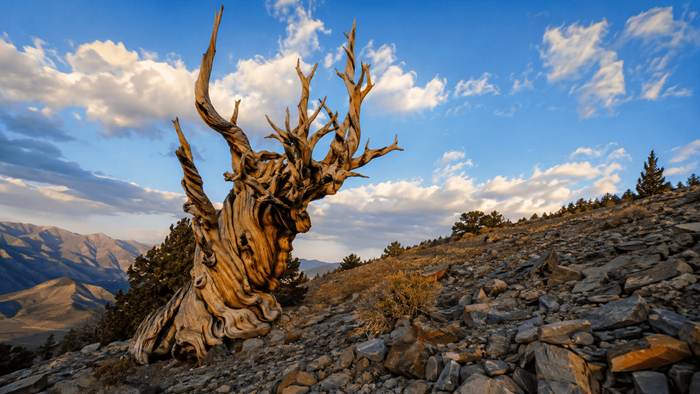
Discover how ancient bristlecone pines survive extreme cold, drought, poor soil and thousands of years of environmental change.
How The World’s Oldest Living Organism Survived 5,000 Years of Climate Change
High among the mountains of the Great Basin, where the landscape can appear almost hostile to life, one of Earth’s most extraordinary survivors grows from bare rock. The Great Basin bristlecone pine, Pinus longaeva, lives where freezing temperatures, drought, powerful winds, thin soils and an exceptionally short growing season make survival a daily challenge.
Some of these trees have survived for more than 5,000 years. One documented Great Basin bristlecone pine in California has been dated to more than 5,000 years old, making the species the longest-lived non-clonal plant known.
That age is difficult to comprehend. A tree that began growing thousands of years ago could have been alive before the construction of the Great Pyramid of Giza. It was already ancient when civilizations were developing writing systems, cities and long-distance trade networks. Empires appeared and disappeared while the tree continued its extraordinarily slow struggle against the mountain environment.
The secret is not that bristlecone pines somehow defeat harsh conditions. They embrace them. Their remarkable longevity is closely connected to the very environment that makes them look so vulnerable. They grow slowly, conserve resources, isolate damage and occupy exposed locations where many of the threats that destroy ordinary forests are greatly reduced.
- Scientific name: Pinus longaeva
- Maximum documented age: more than 5,000 years
- Typical habitat: exposed mountain slopes and ridges
- Elevation: approximately 6,500 to 11,000 feet in parts of its range
- Natural range: mainly California, Nevada and Utah
- Needles: commonly arranged in bundles of five
A Forest Built for an Almost Impossible Environment
The Great Basin is not the sort of place most people associate with ancient forests. It is a vast interior region of mountains and valleys in the western United States, much of it characterized by a cold desert climate. Great Basin National Park, for example, receives an average of less than 10 inches of precipitation annually, with much of its moisture arriving as winter snow.
The mountains provide an escape from the heat of the lower desert, but that escape comes at a price. At high elevations, temperatures can plunge below freezing, winds can be fierce, and the period during which trees can actively grow is extremely short.
For a conventional forest tree, such conditions would be disastrous. A bristlecone pine has evolved to make them manageable.
The trees often grow just below or around the upper limits of tree growth, occupying rocky ridges and exposed slopes where other vegetation struggles. Their surroundings may contain little grass, brush or competing forest. The landscape can look almost empty, with isolated trees scattered across limestone, dolomite and other rocky surfaces.
This apparent emptiness is one of the bristlecone's greatest advantages.
There is less competition for water and nutrients, fewer neighbouring trees to shade them, and in some locations considerably less vegetation available to carry a wildfire from tree to tree. The barrenness surrounding ancient bristlecone groves can help protect them from large forest fires.
- Cold temperatures slow biological processes.
- Dry conditions limit water availability.
- Rocky soils restrict competition from other vegetation.
- Strong winds shape the trees and increase environmental stress.
- Short growing seasons limit annual growth.
- Sparse vegetation can reduce the spread of wildfire.
The Extraordinary Advantage of Growing Slowly
The most important characteristic of a bristlecone pine may be something that sounds like a weakness: it grows extraordinarily slowly.
In a world where plants normally compete by growing faster, taller and more aggressively, the bristlecone follows another strategy. It invests heavily in survival rather than rapid expansion.
Its wood can become extremely dense. Slow growth produces compact annual layers that are unusually resistant to insects, fungi and decay.
This creates a remarkable paradox. The conditions that prevent the tree from growing quickly also help produce wood that is difficult to destroy.
Some years are so cold or dry that little or no conventional annual growth occurs. Consequently, counting visible growth rings is not always as straightforward as simply assuming that every ring represents one calendar year. Scientists use careful cross-dating and comparisons between living and dead wood to establish reliable chronologies.
Individual trees can therefore spend enormous amounts of time in a state of minimal growth. Instead of producing a large amount of new tissue every year, the tree maintains what it already has.
That philosophy is fundamental to its survival.
For thousands of years, the tree does not need to become a giant. It only needs to remain alive.
Wood That Resists Destruction
The dense, resinous wood of bristlecone pines provides protection against several biological threats. Insects and decay organisms that can rapidly damage less resistant trees have a much harder time penetrating and consuming this exceptionally durable material.
The tree can also tolerate having large portions of its structure die while other sections remain alive. Instead of treating the death of one branch or section as the death of the entire organism, the bristlecone effectively compartmentalizes its existence.
This ability is one of the keys to understanding how a tree can appear almost dead while continuing to live.
The Tree That Can Die Without Dying
Walk among ancient bristlecone pines and the first impression can be misleading. Their trunks may be twisted, bleached and partly stripped of bark. Huge limbs can be dead. In some specimens, only narrow strips of living bark appear to connect surviving branches.
Yet the tree can remain alive.
This is possible because of an unusual structure known as sectored architecture. Individual root systems can primarily support particular portions of the tree above them. When erosion exposes a root and that root eventually dies, the corresponding section of the tree can die as well without necessarily killing the rest.
Instead of maintaining one completely integrated living structure, the ancient tree can function as a collection of surviving sections.
It is a brutally efficient strategy.
Rather than spending precious resources repairing every damaged part, the tree allows some portions to be sacrificed. Living sections continue producing energy through photosynthesis while dead wood remains as a kind of skeletal framework.
This means the tree's twisted appearance is not simply evidence of age. It is evidence of survival.
- Roots can support particular sections of the tree.
- Exposed roots may die as erosion progresses.
- The section above a dead root can die independently.
- Other portions can continue photosynthesizing.
- Dead wood reduces the amount of living tissue that must be maintained.
- The surviving tree can therefore persist even after extensive structural damage.
Surviving Drought by Refusing to Waste Water
Water is one of the greatest limitations facing any plant in the Great Basin. Even though the ancient trees live in the mountains rather than the hottest desert valleys, their soils can be extremely dry and their growing season short.
The bristlecone's strategy is not to consume large quantities of water. It is to make the most of what it can obtain.
Its narrow needles reduce the surface area through which water can be lost, while the tree's slow metabolism limits its demand for resources. The tree can also enter prolonged periods of dormancy during drought. National Park Service information describes bristlecones as capable of remaining dormant for years under severe drought conditions.
This is radically different from the behaviour of a fast-growing tree in a productive forest. A rapidly growing tree requires a continuous supply of water, nutrients and sunlight to support new leaves, branches and wood. A bristlecone can effectively put much of its biological activity on hold.
When favourable conditions finally return, surviving tissues can resume activity.
The tree therefore does not need every year to be a good year.
It only needs enough good years, separated by enough tolerable bad years, to remain alive.
Needles That Stay Useful for Decades
Another unusual feature of the bristlecone pine is the longevity of its needles. Unlike many trees that replace foliage relatively frequently, bristlecone needles can remain attached for many years.
This is particularly valuable in an environment where producing new foliage is expensive and the growing season may be too short to guarantee successful replacement.
A tree that loses its entire supply of photosynthetic needles during a prolonged period of poor conditions would face a serious problem. It would need sufficient warmth, moisture and time to grow replacements. The bristlecone avoids much of that risk by keeping its existing foliage for unusually long periods.
The result is another example of the same overall strategy: conserve what already exists.
Every retained needle represents resources that do not have to be spent replacing it.
The needles also grow in dense bundles around the branches, giving the tree its characteristic bottle-brush appearance. This unusual foliage is one of the easiest ways to distinguish a Great Basin bristlecone from a nearby limber pine.
When Wind Becomes a Sculptor
Few trees look as though they have been physically sculpted by the weather as a mature bristlecone pine.
Branches twist sideways. Trunks lean away from prevailing winds. Portions of the tree become bare and pale. Some specimens look more like ancient driftwood than living organisms.
Wind is not simply cosmetic. At high elevations, persistent winds can increase water loss, damage branches and expose the tree to freezing conditions. Snow and ice can also place enormous mechanical stress on limbs.
Yet the bristlecone's slow growth and compact structure help it endure.
The tree often grows low and irregular rather than developing the tall, straight profile associated with trees growing in sheltered forests. This reduces its exposure to some of the mechanical forces that would affect a tall, rapidly growing crown.
Its appearance is therefore a record of environmental pressure.
Every twisted branch represents a negotiation between growth and survival. Every dead section marks a part of the tree that was abandoned so that another part could continue.
Five Thousand Years Written in Wood
The great age of bristlecone pines gives them another extraordinary role: they are natural archives of past climate.
Tree rings can preserve information about growing conditions. Variations in ring width can reflect differences in factors such as temperature and moisture, allowing scientists to reconstruct patterns of environmental change far beyond the period covered by modern weather instruments.
Bristlecone tree-ring records extending roughly 9,000 years have been constructed when living and dead wood are combined.
This does not mean that one living tree contains an uninterrupted 9,000-year record. Instead, scientists can overlap records from living trees, dead trees and preserved wood. By matching patterns in their rings, researchers can construct long chronological sequences.
The technique is known as dendrochronology.
It transforms an apparently dead piece of ancient wood into a historical document.
A narrow ring can indicate a difficult growing period. A wider ring can indicate more favourable conditions. When the same pattern appears across several trees, scientists can gain greater confidence that the signal represents a regional environmental event rather than something affecting one individual tree.
- Tree rings: preserve evidence of changing growing conditions.
- Cross-dating: allows overlapping tree records to be aligned.
- Living trees: provide records extending into the present.
- Dead wood: extends chronologies further into the past.
- Ancient wood: can provide environmental information from periods long before instrumental records.
What Five Thousand Years of Climate Change Can Teach Us
Calling the bristlecone pine a survivor of climate change requires an important distinction. The species has experienced enormous natural changes in climate over thousands of years, including shifts associated with ice ages and warmer periods. But the fact that individual trees survived past climate changes does not mean they are automatically protected from every modern climate threat.
Ancient trees demonstrate resilience, but resilience has limits.
Modern warming is changing conditions in mountain ecosystems. Researchers have found unusual growth patterns in high-elevation bristlecone populations during the second half of the twentieth century. One study reported that ring growth at several upper-elevation sites was greater than during any other 50-year period in the previous 3,700 years, with increasing high-elevation temperatures identified as a likely important factor.
At first glance, faster growth might sound beneficial. A tree growing more rapidly should have an advantage, shouldn't it?
Not necessarily.
The ancient bristlecone strategy developed under conditions where cold, dryness and slow growth were part of the protective environment. Warmer conditions can alter that balance. A longer growing season may provide additional opportunities for growth, but warming can also increase drought stress, change snowpack, alter soil moisture and allow organisms or disturbances to move into habitats where they were previously limited.
Great Basin National Park identifies warming climate, mountain pine beetles and white pine blister rust among threats affecting its white pine species, including Great Basin bristlecone pine.
The lesson is therefore more complicated than simply saying that bristlecone pines have survived thousands of years and will continue to do so.
They survived because their environment and their biology formed an extraordinary partnership.
Change the environment substantially enough, and that partnership can change too.
The Strange Protection of a Nearly Barren Landscape
Fire is one of the most important ecological forces affecting forests, but ancient bristlecone groves can possess a natural advantage because they often grow in landscapes where there is little vegetation to carry flames.
At high elevations, isolated trees can stand among exposed rock and sparse vegetation. A lightning strike may still damage or kill an individual tree, but the absence of continuous forest fuel can make it harder for fire to sweep through an entire grove.
This is another example of the strange relationship between adversity and longevity.
The landscape looks poor because it supports little vegetation. That same poverty can help protect ancient trees from some of the disturbances that destroy richer forests.
It is not an absolute defence. Wildfire remains a threat wherever conditions permit fire to spread. But the high-elevation habitat of the bristlecone is sufficiently different from dense forests that the ecological consequences can also be different.
The Tragedy of Prometheus
One of the most famous stories in bristlecone history concerns a tree called Prometheus.
In 1964, geographer Donald Currey was studying glacial history in the Wheeler Peak area and was investigating the growth rings of ancient bristlecone pines. A tree subsequently identified as Prometheus was cut down after permission had been granted for scientific research. Examination of the wood revealed 4,862 countable growth rings, and the tree was estimated to have been approximately 4,900 years old.
The event became an enduring lesson in the importance of protecting irreplaceable natural records.
Prometheus could not be replaced. Even if another bristlecone eventually reached a similar age, the individual tree that had witnessed thousands of years of environmental history was gone.
Its remains nevertheless contributed to scientific understanding. Tree-ring research helped establish long climate chronologies and contributed to broader work involving radiocarbon dating and environmental history.
The story also changed the way ancient bristlecone pines were viewed. They were no longer simply unusual old trees. They were recognised as irreplaceable biological archives.
Methuselah and the Search for the Oldest Tree
The name Methuselah has become synonymous with ancient bristlecone pines. The tree grows somewhere in California's White Mountains, but its exact location is deliberately kept secret to protect it from vandalism and unnecessary human disturbance.
The precise age figures reported for Methuselah vary between sources and dating methods, but it is generally recognised as one of the oldest known individual living trees. Another bristlecone from the region was later dated to more than 5,000 years old, demonstrating that individual trees can exceed the age long associated with Methuselah.
The secrecy surrounding the oldest trees illustrates an unusual conservation problem.
Their fame can itself become a threat.
A tree that has survived for five millennia can be damaged in minutes by people seeking a photograph, carving a name into its bark or breaking off a piece as a souvenir. Ancient wood is exceptionally valuable scientifically precisely because it has survived for so long.
Keeping the most famous specimens anonymous allows researchers and conservation authorities to protect them while still making the broader bristlecone ecosystem available for education.
What Does 5,000 Years Actually Mean?
It is easy to treat the age of an ancient tree as an impressive number and move on. But five thousand years is more meaningful when placed against human history.
A tree that is 5,000 years old was already growing thousands of years before the classical civilizations of Greece and Rome. It predates the Roman Empire by more than two millennia. It was ancient before many of the civilizations that dominate school textbooks had even emerged.
During its lifetime, coastlines changed, glaciers advanced and retreated, deserts expanded and contracted, and atmospheric conditions fluctuated. Humans changed from small agricultural communities into societies capable of building cities, empires, roads, ships and global communication networks.
The tree experienced none of these events as humans did. It simply continued growing.
Its history is written not in stories, monuments or documents, but in wood.
That makes the bristlecone pine a remarkable bridge between human history and Earth's environmental history.
The Survival Strategy of an Ancient Tree
There is no single adaptation responsible for the extraordinary lifespan of Pinus longaeva. Instead, its longevity appears to emerge from a collection of complementary strategies.
The tree grows slowly. Its wood becomes dense and durable. Its foliage can persist for many years. It can tolerate drought and dormancy. Its root and vascular structure allow sections to die without necessarily killing the whole organism. It lives in exposed environments where competition, insects, decay and wildfire can sometimes be reduced.
Each adaptation reinforces the others.
- Extreme longevity: individuals can survive for more than five millennia.
- Slow growth: reduces resource requirements and produces dense wood.
- Partial dieback: allows the tree to abandon damaged sections.
- Sectored architecture: helps living sections continue after other portions die.
- Long-lived needles: reduce the need to replace foliage frequently.
- Dormancy: allows survival through severe drought and poor growing conditions.
- Resinous wood: provides resistance to decay and biological attack.
- Rocky habitat: reduces competition from other plants.
- High elevation: creates conditions in which many forest threats are reduced.
None of these characteristics would necessarily produce a 5,000-year-old tree by themselves. Together, however, they create one of the most effective long-term survival strategies in the plant kingdom.
Is the Bristlecone Pine Really the World's Oldest Living Organism?
The answer depends on how the word organism is defined.
Great Basin bristlecone pines are widely described as the oldest known non-clonal organisms or the longest-lived non-clonal trees. This distinction matters because some clonal organisms can persist for much longer by continually producing genetically identical stems from a connected root system.
For example, the famous Pando aspen clone in Utah has been estimated to be many thousands of years old, potentially around 16,000 years. But Pando's age refers to the age of the clonal organism rather than one individual tree trunk.
A bristlecone pine achieves its extraordinary age as an individual rooted tree.
That is what makes its survival so remarkable.
It does not continually replace itself with genetically identical shoots and claim the passage of time. The same individual tree can persist for thousands of years, losing branches, sections and living tissue while maintaining enough functioning structure to continue.
Can They Survive Another 5,000 Years?
No scientist can answer that with certainty.
The bristlecone pine has survived enormous environmental changes, but its history is not proof that future conditions will remain within the limits of its tolerance. Modern climate change is occurring alongside other pressures, including altered fire regimes, pests, pathogens and changing mountain hydrology.
At the same time, the species possesses precisely the characteristics that have allowed it to survive for thousands of years. Its extraordinary genetic and physiological adaptations make it one of the most resilient trees on Earth.
The important point is that resilience is not the same as invulnerability.
A five-thousand-year-old tree is not indestructible. It is simply extraordinarily good at surviving conditions that would kill most other trees.
That distinction may be the most important lesson hidden within its ancient wood.
A Living Time Capsule on the Mountain
There is something profoundly unusual about standing beside an organism that was alive thousands of years before the modern world existed.
The bristlecone pine does not look powerful in the conventional sense. It is rarely the tallest tree on the landscape. Its trunk may be partly dead. Its branches can be skeletal. Its bark can appear battered by centuries of wind and snow.
Yet those apparent weaknesses are the visible evidence of its strength.
The ancient tree survives not by conquering its environment but by yielding to it. It allows portions of itself to die. It grows only when conditions permit. It stores resources in exceptionally durable tissues. It waits through drought. It protects its remaining living sections. It occupies a harsh landscape where competition is limited.
For more than five thousand years, this strategy has worked.
Its tree rings provide scientists with a record of changing environmental conditions stretching back thousands of years. Its twisted form records the physical forces of its mountain home. Its survival demonstrates how life can persist through extraordinary environmental stress when biology and habitat are perfectly matched.
The Great Basin bristlecone pine therefore represents much more than an old tree. It is a biological record of deep time, a survivor of changing climates and a living example of how evolution can turn extreme adversity into an advantage.
Sources and Further Reading
- Great Basin National Park — Identifying Bristlecone Pines — National Park Service guidance on the biology, appearance, habitat and exceptional longevity of Great Basin bristlecone pines. This is a useful primary reference for understanding Pinus longaeva and its adaptations to high-elevation environments.
- Great Basin National Park — The Prometheus Story — National Park Service historical material documenting the famous Prometheus bristlecone pine, its scientific study and the circumstances surrounding its removal in 1964. It provides important context for the history of bristlecone research and conservation.
- Great Basin National Park — Plants — National Park Service information describing the plant communities, elevation and environmental conditions of Great Basin National Park. It provides useful ecological context for the harsh mountain environment inhabited by bristlecone pines.
- Great Basin National Park — Tracking White Pine Health — National Park Service research and monitoring information concerning the health of high-elevation white pine species. The resource is relevant to understanding environmental pressures including climate change, pests and disease affecting bristlecone pine ecosystems.
- Salzer, M. W., Hughes, M. K., Bunn, A. G. & Kipfmueller, K. F. — Recent Unprecedented Tree-Ring Growth in Bristlecone Pine at the Highest Elevations and Possible Causes — A peer-reviewed study published in the Proceedings of the National Academy of Sciences examining unusual recent growth patterns in high-elevation bristlecone pines and their relationship with changing climate conditions. It is particularly relevant to the discussion of climate change and long-term growth records.
- NASA Earth Observatory — Paleoclimatology: Climate Close-Up — NASA educational material explaining how ancient bristlecone pine tree rings contribute to the study of past climate. The resource provides useful background on dendrochronology and the value of long-lived trees as natural environmental archives.
- Ferguson, C. W. — Dendrochronology of Bristlecone Pine — Research concerning the use of bristlecone pine growth rings for establishing long chronological sequences. This body of dendrochronological work is important to understanding how ancient wood can contribute to environmental and climate reconstruction.
- National Research Council — Surface Temperature Reconstructions for the Last 2,000 Years — National Academies research examining methods for reconstructing historical climate conditions using natural archives, including tree rings. It provides broader scientific context for interpreting tree-ring evidence in paleoclimate research.
- National Park Service — Bristlecone Pine Ecology and Conservation Resources — National Park Service educational and scientific resources concerning bristlecone pine ecology, habitat, conservation and threats. These materials provide authoritative background for understanding why ancient bristlecone populations are important natural and scientific resources.
Conclusion
Find more at Statuslink Ancient Great Basin bristlecone pines reveal an extraordinary survival strategy shaped by one of the harshest environments in which a tree can live. High in the mountains of the western United States, Pinus longaeva endures freezing temperatures, drought, powerful winds, rocky soils and brutally short growing seasons. Rather than overcoming these conditions through rapid growth, the bristlecone survives by doing almost everything slowly and efficiently. Its dense wood resists decay and biological attack, its long-lived needles reduce the need to replace foliage, and its ability to allow individual sections to die means that damage to one part of the tree does not necessarily destroy the entire organism. This unusual sectored architecture allows ancient specimens to remain alive even when much of their trunks and branches have become dead, twisted and weathered. Their extreme longevity also makes them invaluable natural records of Earth's environmental history. Tree rings preserve evidence of past growing conditions, while overlapping sequences from living and dead wood allow scientists to reconstruct climate records extending thousands of years into the past. Bristlecone pines have already survived enormous natural changes in climate, but their history should not be interpreted as proof that they are invulnerable to modern climate change. Warming temperatures, drought, changing snowpack, pests, pathogens and wildfire can alter the delicate environmental balance that has supported these ancient survivors for millennia. Their greatest lesson may therefore be one of resilience rather than immortality. A tree that can survive for more than 5,000 years does so not by remaining unchanged, but by adapting to its environment, conserving resources and sacrificing what it cannot maintain. The ancient bristlecone pine stands as both a living survivor and a biological time capsule, with its weathered form and microscopic growth rings preserving a story that reaches far beyond recorded human history.